Forestry Mulching vs Bulldozing: Which Way to Clear Land in Houston?
Mulching leaves roots and costs less; a dozer takes everything, topsoil included, and costs more. That is the whole argument in one line; the rest is the exceptions. I run a forestry mulcher and a dozer out of Hockley and I've cleared lots across seven Southeast Texas counties since 2018. Unlike bulldozing, mulching uses a single machine and does not strip the land bare. Call (713) 587-6978 or send three photos of your place. Janine will have a number back to you by tomorrow.
 A FIELD NOTE
How a Forestry Mulcher, a Dozer and an Excavator Each Clear Land
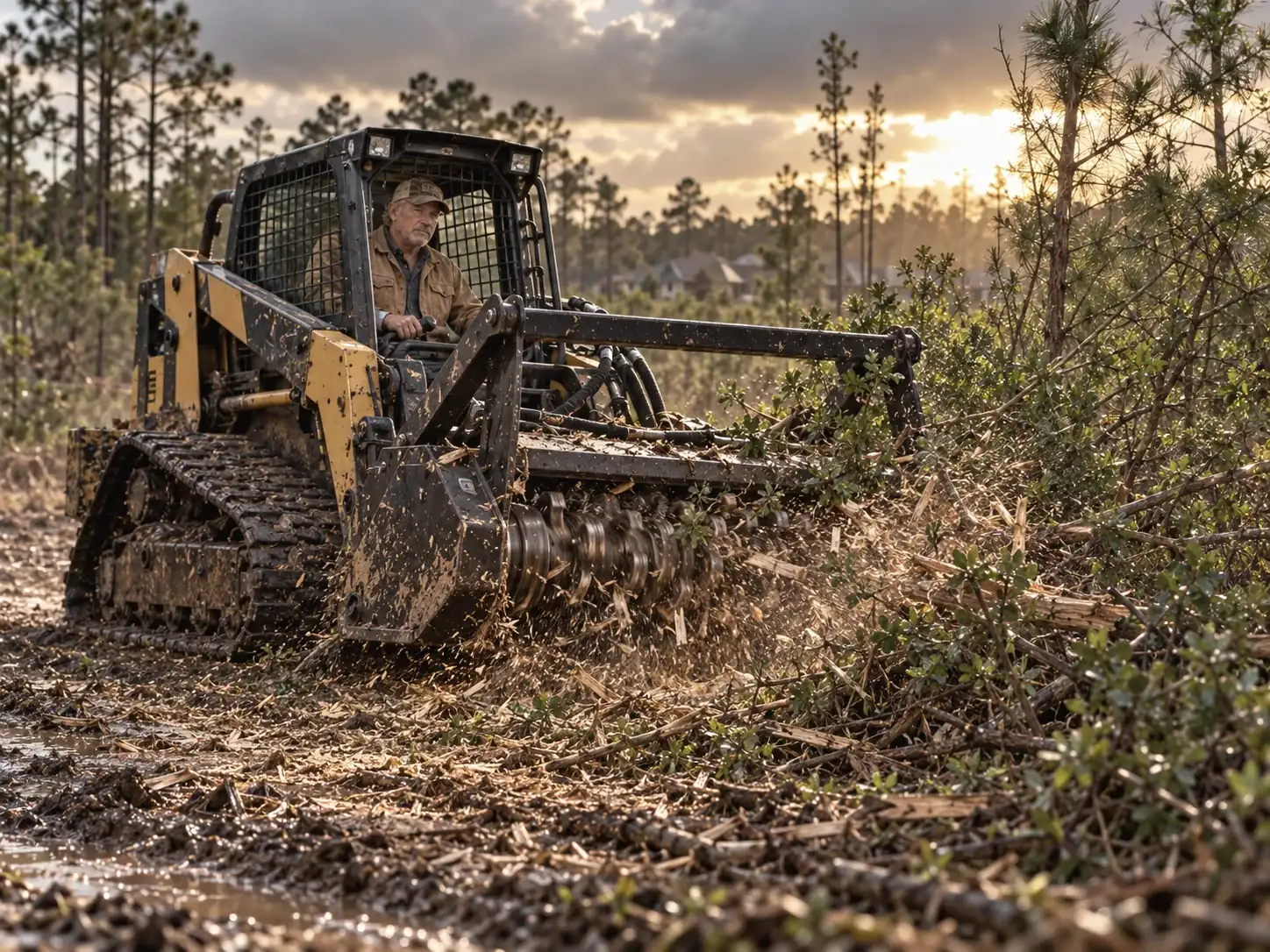
Three land clearing methods, three machines. The mulcher is a skid steer or a tracked carrier with a mulching head: a spinning drum fitted with steel teeth, sharp teeth with carbide tips, that grinds everything standing into wood chips. It will shred vegetation, fell small trees and grind larger trees up to 20 inches down to flush tree stumps. Track or wheel, the mulch stays put. Traditional land clearing is a bulldozer, a Deere or a Cat with a root rake, that pushes trees over, roots and all, into brush piles for a loader and trucks. Excavation is an excavator to pull each root ball out. A brush hog on a tractor is a rotary mower and will not touch 2-inch yaupon; a chainsaw crew is the oldest of the traditional clearing methods. Traditional clearing with a dozer wants dry ground; from November to March on gumbo clay south of FM 1960 it sinks to the belly pan.
Cost per Acre and per Day: Mulch It or Bulldoze It
I give you a range before we move the machine. The address and photos narrow it.
Forestry mulching runs $1,000 to $2,500 an acre. Dozer clearing runs $1,500 to $4,000 and up an acre, plus $600 to $1,200 a load to haul off the piles. By the day: $3,000 for the skid steer to clear brush, transport in, and it eats anything under 8 inches; $4,000 plus transport for the big machine, which eats anything. The dozer's hourly rate looks lower on paper, and then the trucks show up: traditional methods need the labor of multiple machines and a cleanup crew. Mulching is a one-step process: one operator, one machine, a single pass, land cleared when he drives off. On a 5-acre pasture in Waller County last spring the big machine took one day; the dozer quote ran three days and a line of trucks. Wet ground adds a day. A tallow thicket adds a day. I'll say so before we start, not after. Our crews are insured. Call (713) 587-6978 for the number on your lot.
| WORK / UNIT | PRICE RANGE | WHAT CHANGES IT |
|---|---|---|
| Forestry mulching | $3,000 / day | Skid steer; transport included. |
| Dedicated mulcher | $4,000 / day | High-horsepower machine; transport extra. |
| Dozer or mixed work | Quoted after photos | Grade, grub, or haul-off scope sets the cost. |
Want a firm number? Send three photos and the access gate. I will tell you what I can see and what still needs a visit.
Speed: Acres a Day, Mulch vs Dozer
I give you a range before we move the machine. The address and photos narrow it.
The skid steer does 1 to 3 acres a day; the big machine does 4 to 8. A dozer on dry sand knocks down 3 to 5 acres a day, but that is the knocking down, not the piling, burning and trucking that follow. Mulching is faster to finished because it is finished when the machine leaves. On brush and small trees, every sapling and dense vegetation under 8 inches, nothing beats the skid. Storm damage is the same story: fallen trees and tallow on 1.5 acres in Crosby after a May storm were mulched on site in one day, $3,200, no truck. Pipeline right of way, firebreaks, property lines and trails are mulching work; a building site pad is dozer work; site prep for a subdivision is both. Wet ground changes the math: the mulching head floats and the dozer waits for a dry week.
| WORK / UNIT | PRICE RANGE | WHAT CHANGES IT |
|---|---|---|
| Forestry mulching | $3,000 / day | Skid steer; transport included. |
| Dedicated mulcher | $4,000 / day | High-horsepower machine; transport extra. |
| Dozer or mixed work | Quoted after photos | Grade, grub, or haul-off scope sets the cost. |
Want a firm number? Send three photos and the access gate. I will tell you what I can see and what still needs a visit.
Where the Debris Goes: Layer of Mulch, Burn Piles or Haul-Off
Forestry mulching leaves a 2 to 4 inch layer of mulch and nothing to truck; a dozer leaves brush piles you burn or load out; an excavator leaves root balls that only trucks can take. Inside Houston city limits you cannot burn. Outside, TCEQ sets the rules for burning debris and county burn bans shut it down in dry months. Trucking after a dozer runs $600 to $1,200 a load; a wooded acre makes 8 to 12 loads. Wood chips from the mulching head stay put as organic material. They retain moisture through August, suppress the first flush of weeds and invasive plants, and rot in two years, enriching the soil instead of leaving bare topsoil to bake. Call that minimal environmental impact. I call it no pile. Under a slab the pad has to be clean fill, so there we clear the footprint to dirt and chip the rest.
Soil, Erosion and Roots: Environmental Impact on Clay vs Sand
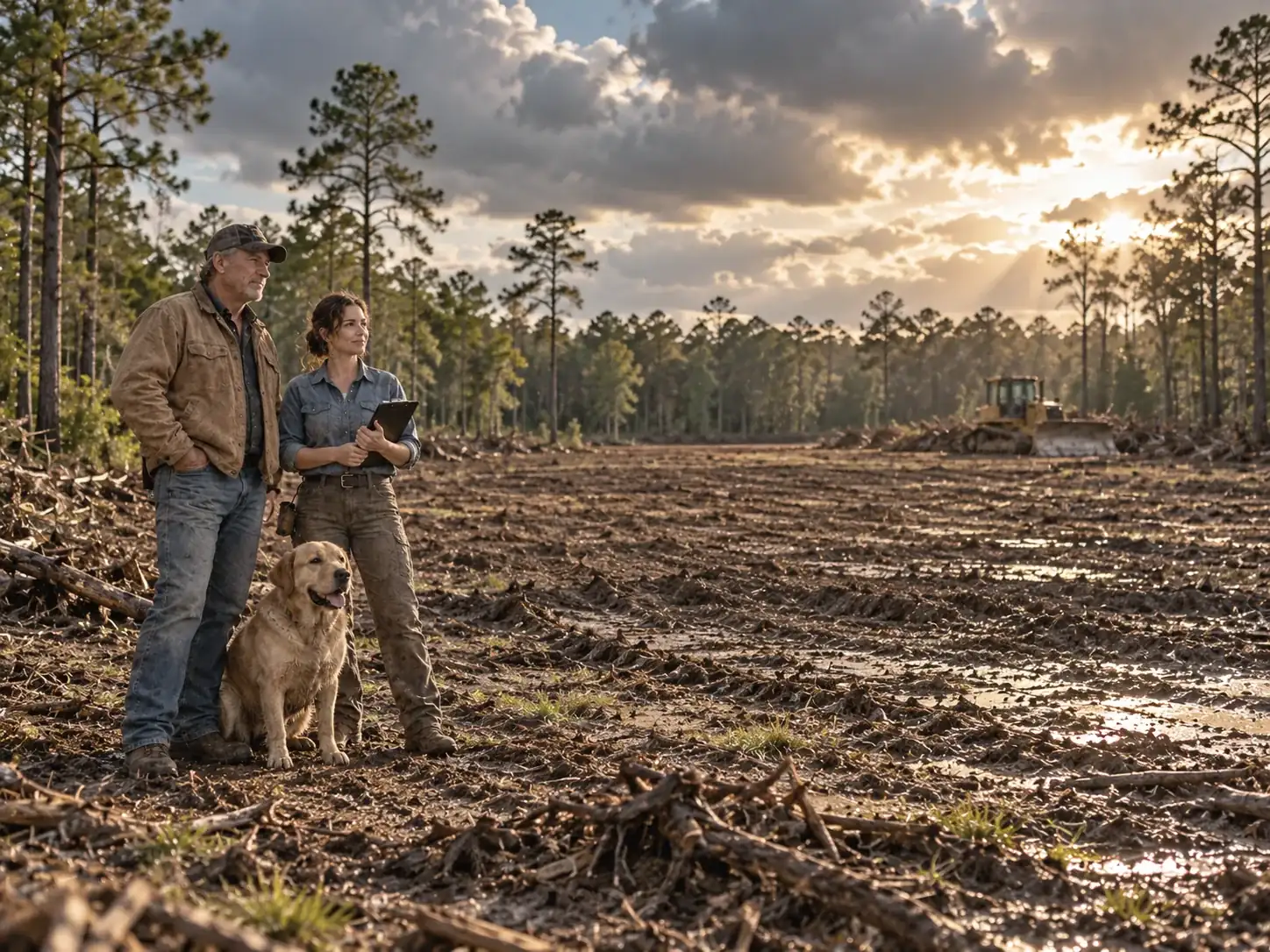
South of FM 1960 it is gumbo clay; north of it, sand; and the two soils want different machines. Clay swells shut when wet, water sits for days, and a dozer cuts ruts you fight for a year. The mulching head floats over it with almost no soil disturbance, and the mulch prevents erosion through the first storm season. Sand drains fast and dozes clean, but bare sand moves with every rain, so on any slope up by Conroe we mulch and doze only the pad. Erosion risks and soil health are the quiet half of the environmental impact. Mulching leaves roots, so tallow sprouts back from a root crown 6 inches down and wants a second pass next spring. Up north they fight buckthorn and multiflora rose; here the underbrush is tallow, yaupon, privet and briar, and if you let a lot overgrow for five years that undergrowth is woody growth 15 feet tall and the overgrowth takes the big machine to clear. A dozer pulls the roots, which a slab needs and a pasture does not.
When You Need a Dozer Anyway: Stumps, Grading and Building Pads
You need a dozer or an excavator when something gets built, because a slab wants the roots out and a pad wants dirt moved. Stumps below grade: mulching leaves them flush, so for a slab or a septic field we grind them out at $150 to $400 each by diameter, or grub them. Grading: the house pad goes 18 inches above the road crown and above base flood elevation on the FEMA flood map, and only a dozer moves that dirt. Inside the mapped floodplain Harris County Engineering issues a development permit first. For property owners clearing a pad site the answer is usually both: the mulching head on the acreage, the dozer on the footprint. On the Conroe lot in the Field Sketches we kept 14 loblolly pines, mulched the understory and roughed the pad in two days, $6,800. Our mulching services stop where the concrete starts; we don't pour it or set septic. Tell me what gets built and I'll draw the line on the sketch.
Which Land Clearing Method Fits Your Lot
If a building pad is next, clearing method matters. A mulcher does not do all the work of a dozer.
Mulch for a view, a pasture or a fence line; bulldoze for a slab. This is how I decide in the cab.
| Your lot | Method |
|---|---|
| Half-acre lot, tallow and yaupon, custom build coming | Mulch, then grub the slab footprint |
| 3 to 10 acres of pasture, bottomland tallow and privet | Big mulcher, 4 to 8 acres a day |
| Fence line, 8-foot path, 2,400 feet | Skid steer, one day, $3,000 |
| Wooded lot, house pad, 14 pines to keep | Mulch the understory, dozer for the pad |
| Commercial pad with detention pond | Dozer and excavator, mulch the buffers |
| Storm debris after a hurricane | Mulch on site, no haul-off |
| Pond, septic field or anything with roots out | Excavator |
| Salt cedar near Galveston Bay | Mulch, then a second pass in spring |
Tallow doesn't die. It waits. A mulcher to clear a homesite in Harris, Montgomery, Fort Bend, Waller, Liberty, Brazoria or Galveston County starts at $3,000 a day. Call (713) 587-6978 or send three photos, and Janine will have the method and the number back to you by tomorrow.
| FACTOR | MULCHER | DOZER | HAND CREW |
|---|---|---|---|
| What comes out | Brush and smaller trees | Brush, timber, and often topsoil | Small patches and tight spaces |
| Ground afterward | Mulch layer; roots usually remain | Disturbed soil; grading possible | Variable, often hand-stacked debris |
| Best fit | Selective brush work and acreage | Pad preparation and major grading | Restricted access or selective details |
Forestry Mulching vs Bulldozing: Questions I Get in the Cab
If your question is about wet ground, Janine will ask me.
Does forestry mulching kill the trees you keep?
No. The mulching head works around the trees you mark and leaves their roots untouched, which is the point of selective clearing. A dozer tears the root plate of every oak it passes, and those trees die two or three years later.
Can a bulldozer knock down trees?
Yes, a dozer with a root rake pushes over trees up to about 24 inches on dry ground. The cost is the roots and the topsoil that come with them, and the piles you burn or truck.
What size trees can a forestry mulcher handle?
The skid steer eats anything under 8 inches; the big machine grinds brush and trees as well up to about 20 inches. A forest of 30-inch pines is a timber job, not a mulching job.
Does forestry mulching remove the stumps and roots?
No. Mulching grinds the stump flush with the ground and leaves the roots in place. For a slab, a driveway or a septic field we grind them out at $150 to $400 a stump or grub them with the excavator. For a pasture, a trail or a view, flush is fine.
How do I get a number for my lot?
Call (713) 587-6978 or send three photos and your address. Janine will have a price and the machine back to you by tomorrow. An on-site look is free inside Greater Houston, and the sketch and the invoice from a job like yours are on the page.
Send three photos.
Get a straight number.
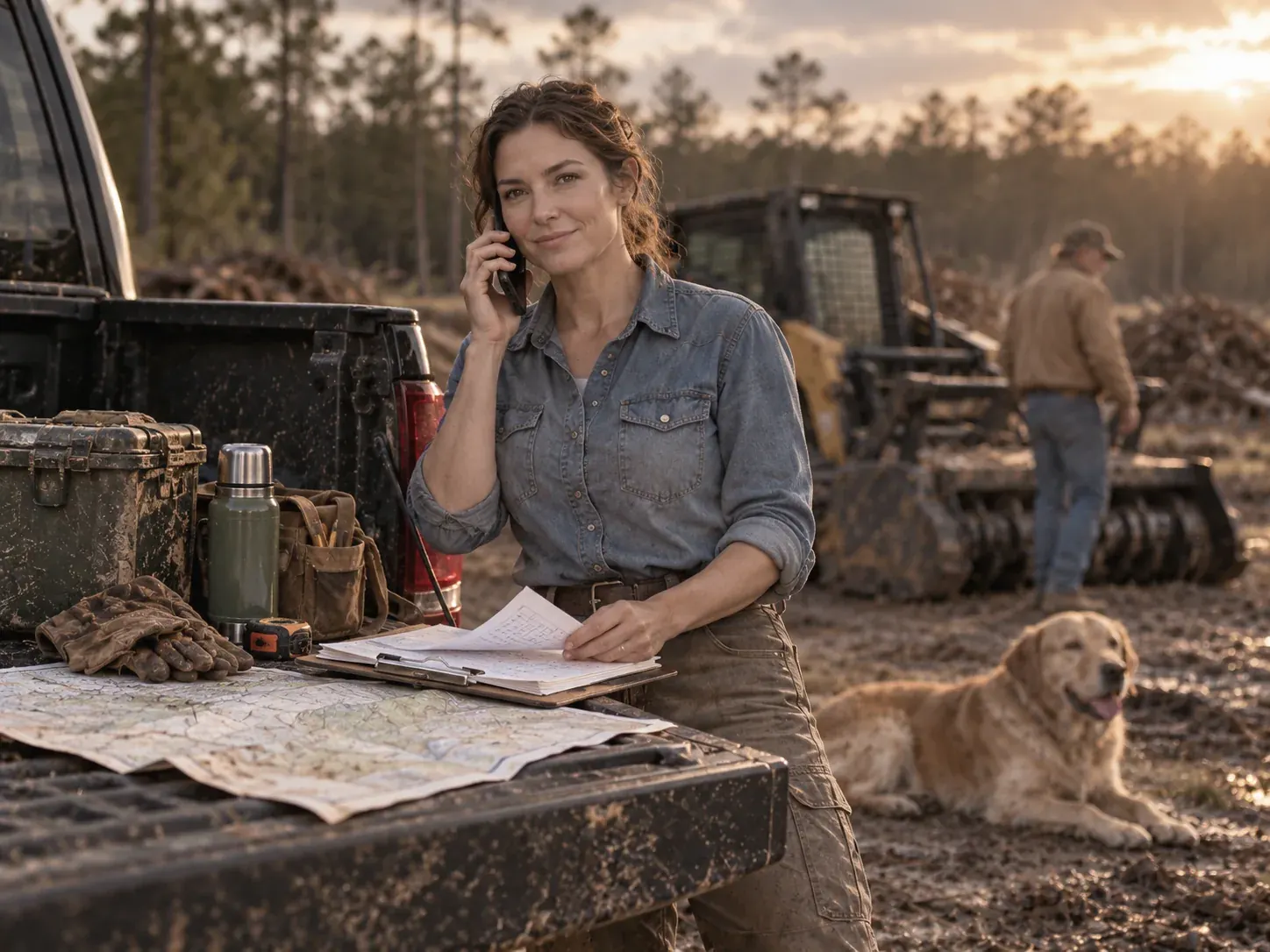
Janine reads each request and manages the schedule. I check the photos. If I need to see the land myself, I will tell you.
Tell Janine about your lot.
The address. The growth. Three honest photos.
Design preview. This form does not send or store information until a backend is connected.