Brush Clearing in Houston, TX: Texas Land Clearing and Brush Removal by Forestry Mulching
Scrub under your trees is a one-day job for a skid steer mulcher, $3,000 with transport, and it eats anything under 8 inches. Tallow and yaupon thickets add a day. I've cleared undergrowth from Dayton to Fulshear since 2018, and the fence line sketch from Hockley is on this page. Wet ground adds a day. Call (713) 587-6978 or send three photos of your place. Janine will have a number back to you by tomorrow.
 HOUSTON, TEXAS
Clearing Undergrowth Without Taking the Trees
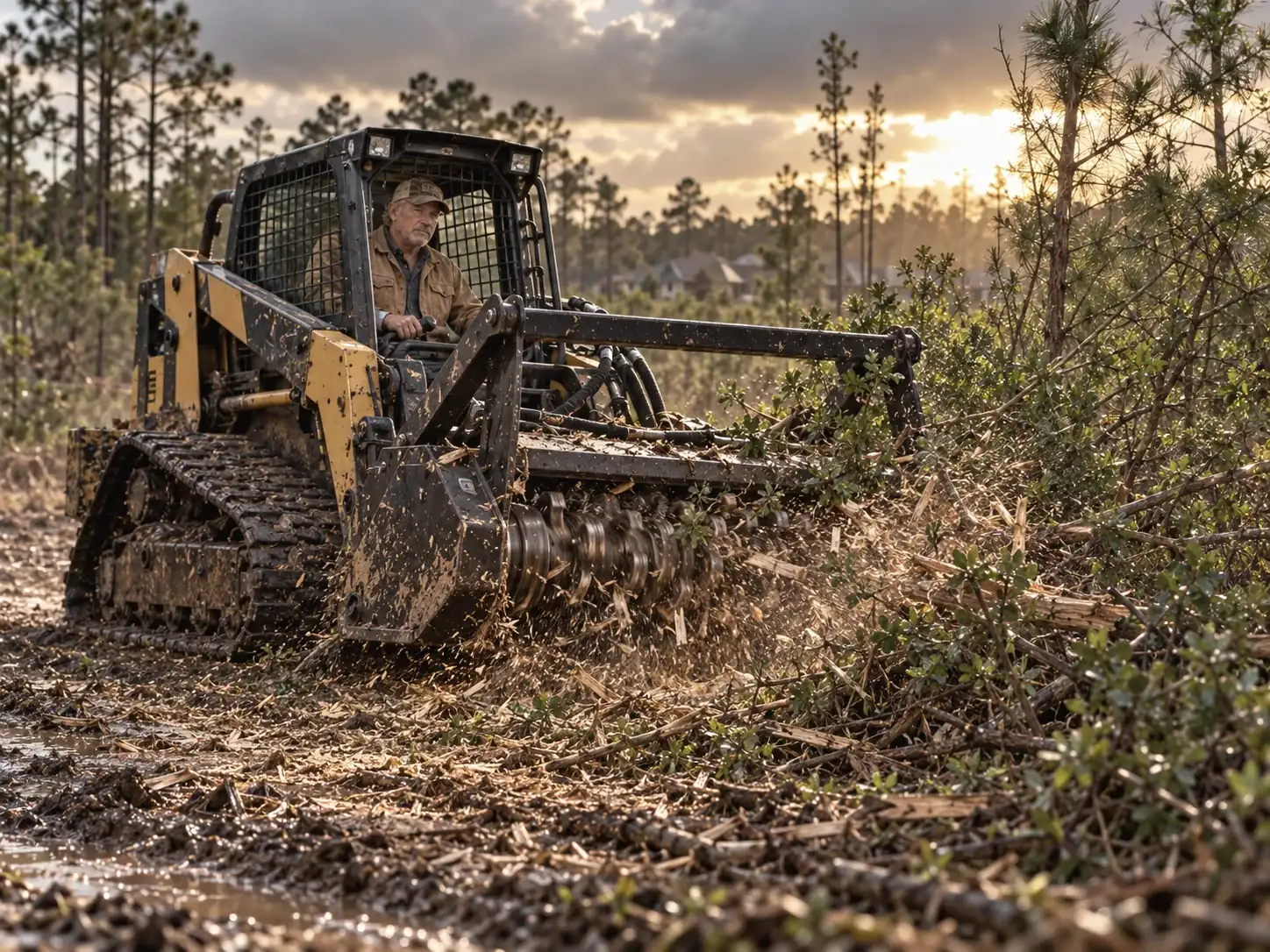
Undergrowth work takes out everything under 8 inches and leaves every trunk you point at. The skid steer mulcher works between the trees, carbide teeth on a drum, and grinds yaupon, privet and small tallow flush with the dirt. The chips stay down as ground cover. We clear brush under oaks and pines without barking the keepers because the head is 6 feet wide and the operator can see both ends of it. Underbrush removal on a wooded acre north of FM 1960 is one day; on our jobs in Spring and Tomball the understory is yaupon and young sweetgum on sand, and it clears clean. South of FM 1960 it is tallow on clay, and that adds the day. You see sky through the trees by Friday.
Scrub Cutting vs. Landscape Clearing vs. Lot Clearing: Types of Land and Clearing Work
Scrub cutting, landscape clearing and clearing a whole parcel are professional land clearing with the same machine pointed at different ground. Scrub is the low stuff: yaupon, privet, dewberry, tallow sprouts, anything you cannot walk through. Landscape clearing is scrub plus the small trees around a house, kept tidy to a line. The whole lot is brush and trees, the whole parcel down to grade for a build. The price follows the stems per acre, not the name. Property owner or land developer, you get the same two machines and the same day rate. What we do not do is one dead oak in a front yard; that is a tree service, and I know three. Send photos and I will tell you which name it gets and what it costs.
Mulching Services vs. Rotary Cutter vs. Hand Crew for Brush
Pick a method for the result you need, not the machine you saw in a video.
Three ways to cut it. A rotary cutter on a tractor mows anything under 2 inches and leaves it lying; good for a field, useless in a thicket. Mulching with a skid steer takes anything under 8 inches and grinds it to mulch in one pass; the big one takes anything. A hand crew with saws works where no machine fits, 4 feet from a foundation or inside a fence corner, and costs the $1,200 to $1,500 minimum for a short day. Mulching equipment beats the other two on overgrown brush because nothing is left to pick up. Forestry mulchers do not make brush piles, and piles are how most clearing debris turns into a TCEQ question or a burn ban fine. Our mulching services run by the day.
Forestry mulching
Cuts brush and many smaller trees into a mulch layer. Roots normally remain in the ground.
Understand the method ↗METHOD 02Dozer work
Pushes vegetation and shifts ground. Useful when the next step needs grading or grubbing.
Understand the method ↗METHOD 03Selective clearing
Keeps marked trees while a crew opens the view, fence line, or building area.
Understand the method ↗Brush and Tree Clearing on Overgrown Rural Properties and Commercial Land
Overgrown land in Harris County is tallow, privet, yaupon and hackberry that got ten years alone, and dense brush like that runs $2,500 to $3,500 an acre to clear. Light scrub runs $1,500 to $2,000. Trees and brush come down together: the drum takes the tallow to 2 inches below grade, because tallow comes back from the root if you leave the crown. Vegetation removal on a parcel like this is one day for a half-acre with the skid steer, and the whole stand is unwanted vegetation to the last stem. Starting a new construction project on overgrown ground means cutting first, then site preparation services for the pad, priced on a second line. Get your property cleared before the survey crew comes, or they bill you for the bushwhacking.
Selective Clearing and Land Management: Keep the Mature Trees, Remove the Undergrowth
Selective clearing keeps the mature trees and takes the undergrowth, and it costs about 20 percent more per acre than a full clear because the operator slows down near every trunk. You flag the keepers with ribbon, or I sketch them from your photos. We leave a 3-foot mulch ring around each keeper and do not bark the trunks. On a wooded acre north of Highway 290 we usually keep 10 to 14 pines and oaks and the understory goes to mulch. Land management on rural properties works this way every three to five years: clear the undergrowth, keep the canopy, and the ground stays usable land for grazing or walking. That is improving land, not stripping it, and long-term land usability is the point. Erosion on sand stays near zero because the chip layer stays.
Fence Line Clearing, Trails and Firebreaks on Pasture and Ranch Acreage
Fence line clearing is a skid steer job: an 8-foot path along the wire, about 2,400 feet in a day. That is the Hockley sketch: 2,400 feet of yaupon and post oak sprouts along a fence, one day, skid steer, $3,000. Trails through woods run the same width and the same rate. Firebreaks on a ranch toward Waller or Brazoria run 12 to 20 feet wide, and we clear them to mineral soil where the county burn ban history says to. Fence lines on a cattle place are where tallow starts, because birds sit on the wire and seed it. Clear your fence lines every three years and the pasture behind them stays open. Across Central Texas that is cedar work; here it is tallow and yaupon.
Bush Hogging and Brush Control for Fields and Pastures
Bush hogging is mowing, not clearing, and I say so because people call for one and need the other. A tractor and rotary cutter knock down grass, weeds and sprouts under 2 inches and leave the stems lying. It keeps grazing land open once it is open. It does nothing to a yaupon thicket or a tallow stand; those bend, the blade rides over, and they stand back up by June. If your field has anything thicker than your thumb, you need the mulcher first and the bush hog after. We do the cutting; your hay man does the mowing. Brush control services after clearing are a mowing schedule, not a machine. Make your land a field before you treat it like one.
What Clearing Costs per Acre, and Large Acreage Clearing by the Day
I tell you about the wet ground, the extra machine, and the haul-off before work starts. Not after.
Light scrub runs $1,500 to $2,000 per acre; medium growth, yaupon and tallow thickets, $2,500 to $3,500; dense timber with haul-off, $4,000 and up. By the day: skid steer mulcher $3,000 with transport, 1 to 3 acres a day; big mulcher $4,000 plus transport, 4 to 8 acres a day, which is the machine for large acreage clearing. Minimum trip charge $1,200 to $1,500. Wet ground adds a day. Houston has two seasons: wet, and about to be. Tallow thickets add a day. Haul-off adds $600 to $1,200 a load, and mulching skips it. Every land clearing project is written up by the day and the acre, and the invoice matches the sketch. The free estimate is on your place inside Greater Houston; the photo quote is faster. Call (713) 587-6978 or send three photos and the address. Janine will have the number by tomorrow.
Skid steer mulcher
Per day. Transport included. Trees under 8 inches.
Dedicated mulcher
Per day. Transport is additional. Large timber and dense ground.
Texas Land Clearing and Brush Service Area Around Houston, TX
Our equipment yard is in Hockley. Send the address and Janine will confirm the route.
Harris, Montgomery, Fort Bend, Waller, Liberty, Brazoria and Galveston. Texas land clearing and brush removal changes with the dirt: tallow and yaupon on clay south of FM 1960, pine understory on sand north of it, mesquite and cedar removal toward the coast in Brazoria and Galveston, where USACE wetland buffers also apply. Turner Land & Pine provides land clearing, including forestry mulching to clear land for a build, brush and underbrush work on fence lines, and mesquite removal on coastal pasture, with insured crews. Commercial land for commercial development gets the same day rate as a backyard. Land development along the Grand Parkway and the types of land we see across Texas all come down to stems per acre. We do not pour concrete, set septic or demolish houses. Call (713) 587-6978 or send three photos and your county. Janine answers both.
Clearing Questions, Answered, and How the Free Estimate Works
If your question is about wet ground, Janine will ask me.
How much does brush clearing cost per acre?
$1,500 to $2,000 per acre for light scrub and $2,500 to $3,500 for yaupon and tallow thickets, in Greater Houston. By the day it is $3,000 for the skid steer mulcher with transport. Wet ground and tallow each add a day. The number from three photos holds unless the ground is wetter than the photos show.
Does the brush come back?
Some of it, and tallow and privet are the worst. We grind the crowns 2 inches below grade, which stops most tallow; privet comes back from seed. Mow twice the first summer and the sprouts quit. Land cleared by mulching and then mowed stays open; land cleared and left alone will overgrow in three summers.
Can you mulch pine trees and yaupon?
Yes. Yaupon shreds clean at any size we see. Pine under 8 inches goes through the skid steer; bigger pine takes the big mulcher or a saw first. Pine chips make the best ground cover of anything we cut, and they hold sand through the first spring rain. Oak over 12 inches wears the carbide teeth fast, so it costs more.
How many acres can you clear in a day?
The skid steer mulcher clears 1 to 3 acres a day; the big one 4 to 8. Dense tallow and wet clay cut those in half. Clearing work on 10 acres of medium growth is two to three days. Janine books by the day, so the price is set before the trailer drops.
Can you clear dead timber left from storms?
Yes. After Harvey we cleared storm debris for a year, and we still do it every spring. Downed hackberry and tallow mulch on site with no haul-off, and a storm-hit acre or two is usually one day. Root balls bigger than the drum get pushed into a pile and cut down first. Tree removal services for a standing dead oak by the house are a tree service job, not ours.
Do you give a free estimate, and how do I get it?
Yes. Call (713) 587-6978 or send three photos and the address and Janine has a number back by tomorrow; the on-site estimate is free inside Greater Houston. Land clearing services are priced by the day and the acre, in writing, and the invoice matches the sketch. Land services like grading or a pad are on a second line.
Send three photos.
Get a straight number.
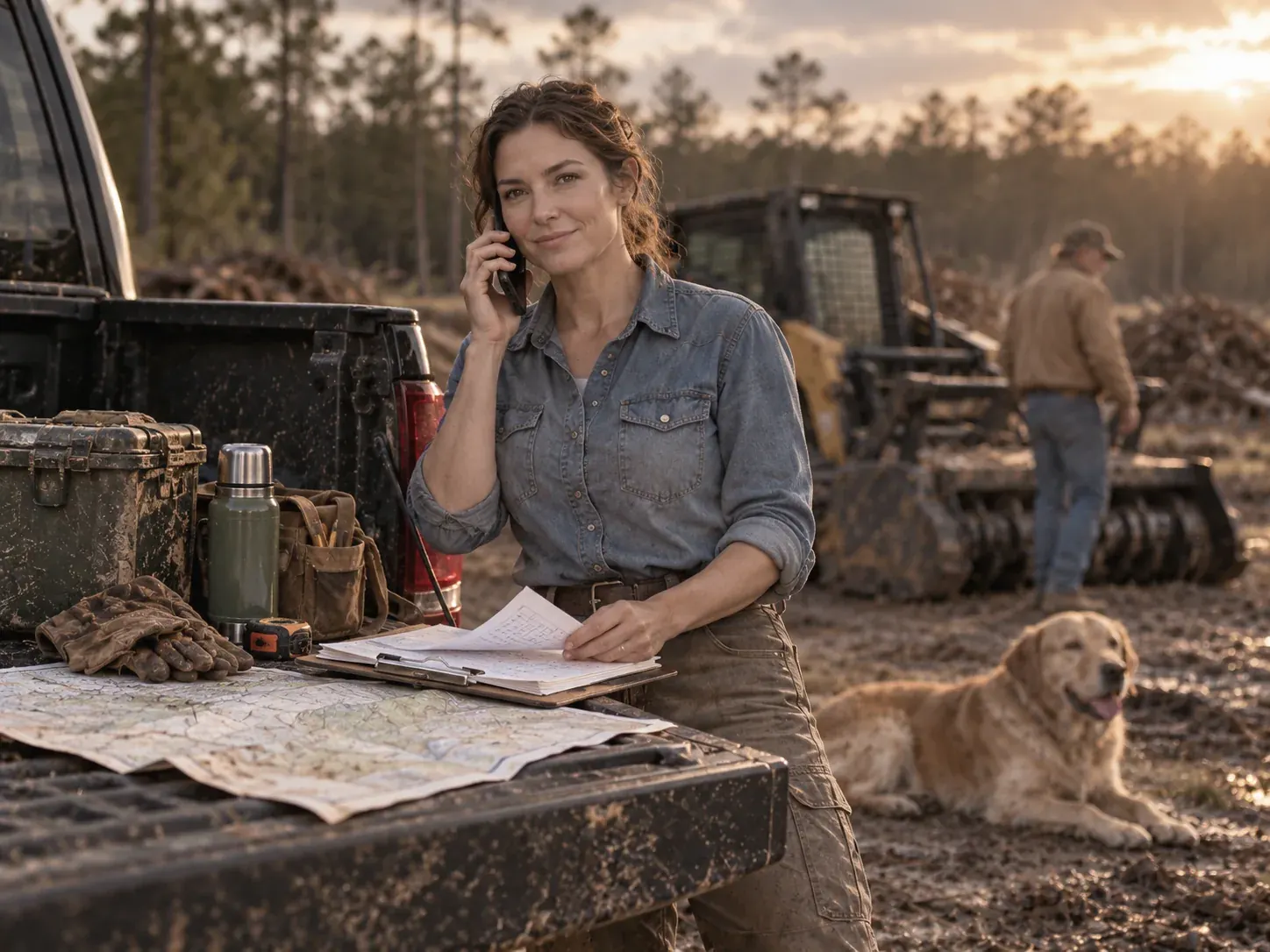
Janine reads each request and manages the schedule. I check the photos. If I need to see the land myself, I will tell you.
Tell Janine about your lot.
The address. The growth. Three honest photos.
Design preview. This form does not send or store information until a backend is connected.