Site Preparation and Site Prep Contractor in Houston, TX: Dirt Work, Grading Services, Excavation, Ponds and Culverts
I ran ditch and detention-pond crews for a Harris County Flood Control District contractor for 19 years before I bought my first mulcher, so the ground side of your build is where I started, and we have built the ground under new houses since 2018. We mulch, grub, cut and fill, build the slab base and set the culvert. We do not pour concrete, set septic or demolish houses. Minimum trip charge $1,200 to $1,500; haul-off $600 to $1,200 a load. Call (713) 587-6978 or send three photos and the site plan. Janine will have a number back to you by tomorrow.
 HOUSTON, TEXAS
Site Preparation Services for Residential and Commercial Construction
Site prep services cover everything between the survey stakes and the forms: land clearing, grubbing, cut and fill, the slab base, the drive, and the detention pond if the county wants one. Both kinds run the same way; a residential lot takes a day or two, commercial construction takes weeks and civil drawings. Home builders and commercial contractors hire us for the phase before the foundation; a homeowner building once hires us for the whole scope of one construction project. On our jobs in Harris County the question is always water: where it sits now and where it goes after we prepare the site. Every site gets a sketch before we start and a sketch of the finished ground after.
Land Clearing and Grubbing to Prepare the Site
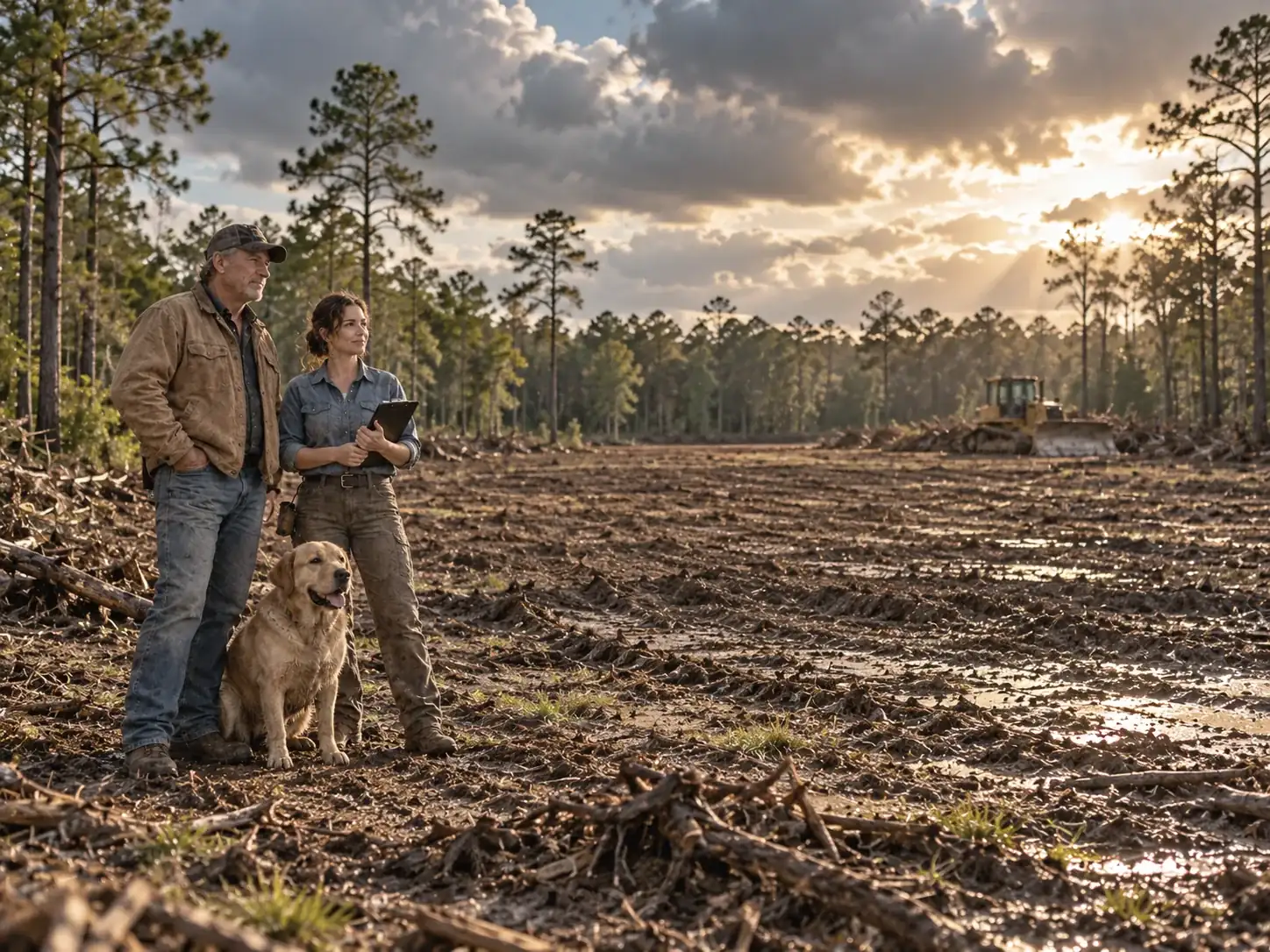
Grubbing is pulling the roots after the mulching, and it is the step a mulcher skips. A mulched lot has crowns and root mats at the surface; a slab on top of them settles when they rot, so we grub the footprint plus 10 feet with the excavator, pile the roots, and either haul them or burn them where TCEQ outdoor burning rules and the county burn ban allow it. Inside Houston city limits that means haul. Tallow roots are the worst; they run 3 feet down and sprout from scraps. Pine roots are shallow and come out clean on sand. Vegetation above ground is the easy half. The half below ground is why grubbing has its own line.
Excavation Services, Cut and Fill, and Rough Grading
Excavation services here mean cut and fill, not basements; nobody digs down in Houston clay. We cut the high side, move it to the low side, and shape the lot so water leaves. A dozer or a skid steer with a grading bucket does the rough grading services to within a couple of inches; finish grading to a tenth of a foot comes right before the forms. We compact fill in 8-inch lifts, because a loose lift settles under a slab for years. Gumbo clay swells wet and shrinks dry, so a slab base built from the native soil we scraped off heaves; we bring select fill. Hire an outfit that owns a laser receiver and a density test, not one who eyeballs it.
The Building Pad Above Flood Elevation in Harris and Fort Bend Counties
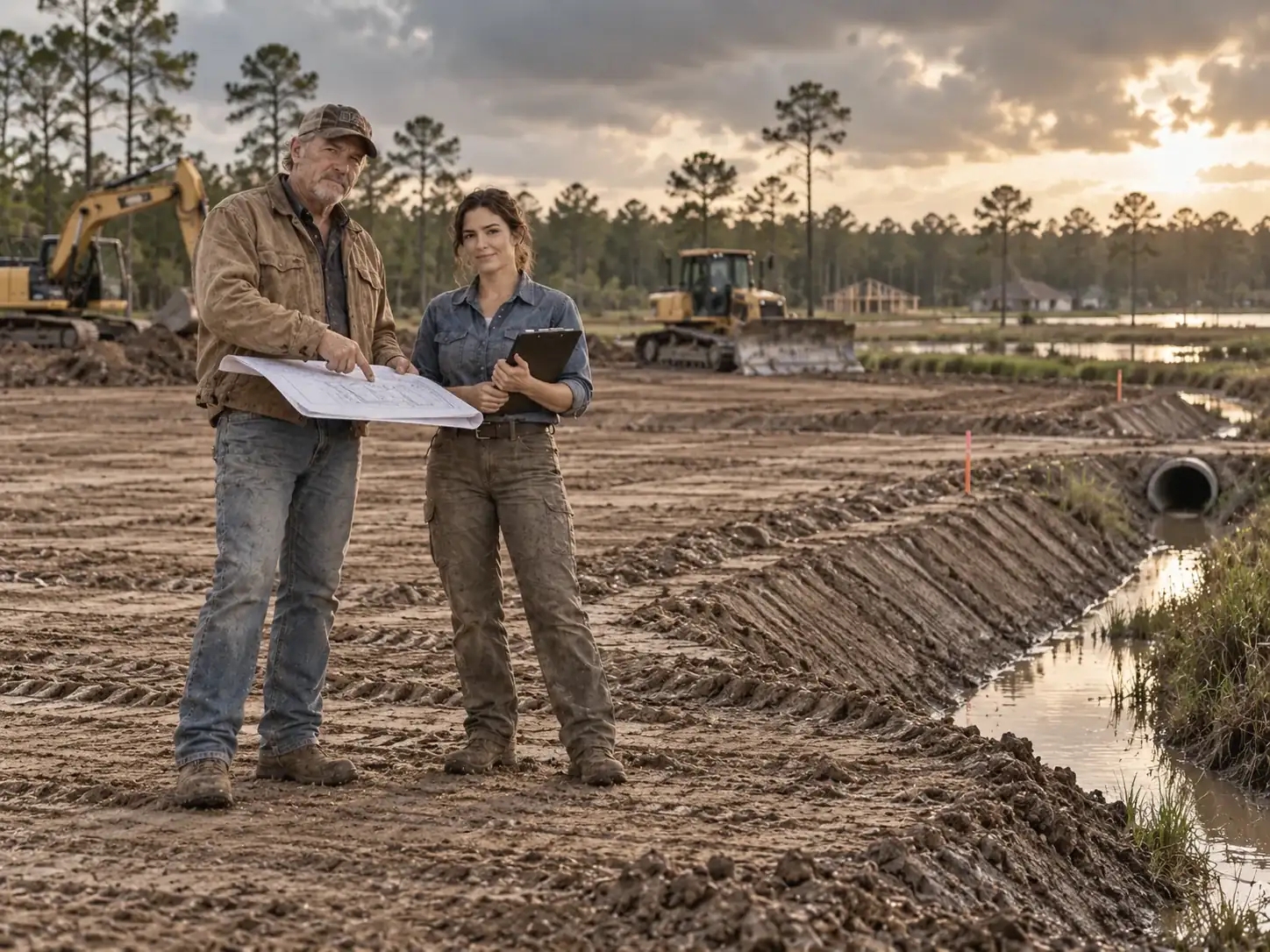
A slab in the FEMA mapped floodplain has to sit above base flood elevation, and Harris County wants the finished slab 1 to 2 feet over it, with a development permit from Harris County Engineering before any fill moves. Fort Bend asks the same. Pad preparation starts with the elevation certificate: we read the base flood elevation, add the county's freeboard, and build to that number with a laser, 10 to 14 yards of select fill per load, rolled in lifts. A 2,400-square-foot slab base built 2 feet up takes about 20 loads. Harris County Flood Control District cares where your fill displaces water, so the pond comes with it. A one-acre wooded lot in Conroe: understory cleared, 14 pines kept, house pad roughed in, two days, $6,800. The sketch and the invoice are on the page, and the ground was usable for the forming crew the day we left.
Driveway Cut and Culvert Placement
The drive is the first thing built and the last thing finished. We cut it 12 to 16 feet wide from the county road to the house, set the culvert at the ditch to the county's size, usually 18 to 24 inches, and cap it with 6 inches of crushed concrete or limestone. Culvert placement is a county permit in Harris, Montgomery and Fort Bend, and the road and bridge office sets the pipe size, not us. Positive drainage means the drive sheds to the ditch, not toward the slab. Low spots in a drive turn to gumbo in a week of rain. Proper drainage at the culvert is what keeps your drive out of your neighbor's pasture.
Detention Pond Excavation for New Houston Lots
Detention ponds hold the rain your new roof and slab used to let soak in, and Harris County requires one on most new business lots and on lots in the floodplain that add fill. The rule of thumb from my HCFCD years: about half an acre-foot of storage per acre of new hard surface, released through a pipe the engineer sizes. We dig the pond, cut the side slopes at 4 to 1 so a mower can run them, and build the outfall. Drainage issues on a lot in Fort Bend or Brazoria usually trace back to a pond that was never cut or an outfall set too high. The engineer evaluates and signs; we move the earth. Improve drainage first and the slab stays dry in May.
Demolition and Haul-Off Before Site Prep
I do not do house demolition. I know a man who enjoys it. What we do before the grubbing is take out what is left: old slabs under 400 square feet, a fallen barn, fence lines, a dead orchard, a septic tank already pumped and crushed by someone licensed for it. The excavator breaks it, we load it, and haul-off runs $600 to $1,200 a load to a C&D landfill. A full house demolition needs an asbestos survey and a City of Houston or county permit, and the demo outfit pulls it; we show up the week after for the grubbing and the slab base. Remove the old before you shape the new. The timeline is about one day of cleanup per 1,000 square feet of broken slab.
Dozer Work, Subgrade Preparation and Bulldozer Service Near You
A dozer pushes; a skid steer finishes. For a lot under two acres the skid steer does the brush, the rough grading and the slab base, and fits through a 78-inch gate. Over two acres, or where the cut and fill runs past 500 yards, the dozer comes, and so does the lowboy, which needs 14 feet of road clearance. Dozer work on gumbo clay stops at the first inch of rain; a tracked skid steer at 6 psi keeps going where the dozer at 12 psi sinks. Subgrade preparation, the site preparation step under a slab or parking areas, is dozer to the number, then a roller, then the laser check. The equipment list is a dozer, a skid steer and an excavator, and all three live at our yard in Hockley, near Waller and Cypress. Dozer the dog rides along.
What Site Work Costs, and the Free Estimate
I tell you about the wet ground, the extra machine, and the haul-off before work starts. Not after.
Minimum trip charge is $1,200 to $1,500 for one machine on one short day. Haul-off runs $600 to $1,200 a load. A one-acre wooded lot with the understory mulched and the house pad roughed in was two days and $6,800 in Conroe, and that is the number most people are asking about. Fill is priced per load delivered and rolled; culverts by the pipe size the county sets; detention ponds by the yard moved. A commercial site gets a line-item bid off the civil drawings. Expert site work is mostly knowing the clay. The estimate is free on-site inside Greater Houston, and I evaluate where the water goes before I price the job. Call (713) 587-6978 or send three photos and the plans. Janine will have the number by tomorrow.
Skid steer mulcher
Per day. Transport included. Trees under 8 inches.
Dedicated mulcher
Per day. Transport is additional. Large timber and dense ground.
Trusted Site Prep Near Houston, TX, Not DFW: Seven Counties
Our equipment yard is in Hockley. Send the address and Janine will confirm the route.
Harris, Montgomery, Fort Bend, Waller, Liberty, Brazoria and Galveston Counties. Fort Bend pulled 9,638 single-family permits in 2025 by the Census Building Permits Survey, and most of those slabs sit on prairie clay; Montgomery pulled 11,597 on sand, where fill holds its height and the pond drains. Liberty County is the Trinity River floodplain, and Brazoria and Galveston carry USACE wetland buffers you do not fill without a delineation. We do not go to DFW; Dallas has its own clay and its own crews. Trusted site work is local: a crew that knows which county's road and bridge office answers the phone. Our crews are insured. General contractors and a first-time builder get the same day rate. Call (713) 587-6978 or send the plans. Janine schedules the machine and the fill trucks together.
Site Work Questions, Answered
If your question is about wet ground, Janine will ask me.
How long does it take to prepare a site for construction?
Two days for one acre with a house going on it: mulch and grub on day one, slab base and drive on day two, if the ground is dry. Commercial projects run two to six weeks by the acreage and the pond. Wet ground adds a day, and on clay that means November through March. Breaking ground on a Monday after a dry week is the schedule I push for.
Can you build the slab base from my engineer's drawings?
Yes. Send the grading plan and the proposed grades; we build to the number on the sheet with a laser, rolled in 8-inch lifts, and your engineer checks it before the forms. Properly prepared means the elevation holds after the first rain. If there are no drawings, I sketch one and we agree on the number before the trucks come.
Do you handle homeowners and big outfits both?
Yes. A homeowner's slab base and a developer's commercial buildings get the same two machines; the difference is the paper and the pond. Homeowner jobs run by the day; the rest runs line by line off the civil drawings. Utility trenching for water and electric to the house is ours; the taps belong to the utility.
Do you need a permit to move fill in Harris County?
Outside the mapped floodplain, no. Inside it, Harris County Engineering issues a development permit before any fill moves, and FEMA's flood map decides which side of that line you are on. Culverts need a county road permit everywhere. We tell you which office; you or your builder pull it.
What about low spots after the build?
Most drainage problems come from a slab base left flat or a drive that dams the ditch. We slope it at 2 percent away from the slab on all sides and leave swales to the pond or the road ditch. A future construction add-on, a shop or a pool, changes the water again, so leave room in the pond. Stability of the slab is water control, nothing else.
How do I get an estimate?
Call (713) 587-6978 or send three photos and the plans, and Janine has a number back by tomorrow. The on-site estimate is free inside Greater Houston. Complete site work, from the first cut to the finish grading, goes on one sheet by step, and the invoice matches it. A precision job like a slab base to a tenth of a foot gets its own line; a simple improvement like a culvert or a drive gets a flat number.
Send three photos.
Get a straight number.
Janine reads each request and manages the schedule. I check the photos. If I need to see the land myself, I will tell you.

Tell Janine about your lot.
The address. The growth. Three honest photos.
Design preview. This form does not send or store information until a backend is connected.